STALLIONSMARESFOALS  |  SERVICES  |   ABOUT US  |  BOARDERS  |  LINKS | SALES | ENDURANCE


This excerpt is from a licensed vet who specializes in horse anatomy.  She is my favorite vet because she is educating people about young horses and letting them grow up - not just physically, but mentally as well.  Visit her site and be prepared to bust every "training myth" you know about horses.

"quote" Just about everybody has heard of the horse's "growth plates," and commonly when I ask 'em, people tell me that the "growth plates" are somewhere around, or in, the horse's knees (actually they're located at the bottom of the radius-ulna bone just above the knee). This is what gives rise to the saying that, before riding the horse, it's best to wait "until his knees close" (i.e., until the growth plates fuse to the bone shaft and cease to be separated from it by a layer of slippery, crushable cartilage). What people often don't realize is that there is a "growth plate" on either end of EVERY bone behind the skull, and in the case of some bones (like the pelvis, which has many "corners") there are multiple growth plates. 

So do you then have to wait until ALL these growth plates fuse? No. But the longer you wait, the safer you'll be. Owners and trainers need to realize there's a definite, easy-to-remember schedule of fusion - and then make their decision as to when to ride the horse based on that rather than on the external appearance of the horse. For there are some breeds of horse - the Quarter Horse is the premier among these - which have been bred in such a manner as to LOOK mature long before they actually ARE mature. This puts these horses in jeopardy from people who are either ignorant of the closure schedule, or more interested in their own schedule (for futurities or other competitions) than they are in the welfare of the animal.

The process of fusion goes from the bottom up. In other words, the lower down toward the hoofs you look, the earlier the growth plates will have fused; and the higher up toward the animal's back you look, the later. The growth plate at the top of the coffin bone (the most distal bone of the limb) is fused at birth. What this means is that the coffin bones get no TALLER after birth (they get much larger around, though, by another mechanism). That's the first one. In order after that:

2. Short pastern - top & bottom between birth and 6 mos.
3. Long pastern - top & bottom between 6 mos. And 1 yr.
4. Cannon bone - top & bottom between 8 mos. And 1.5 yrs.
5. Small bones of knee - top & bottom on each, between 1.5 and 2.5 yrs.
6. Bottom of radius-ulna - between 2 and 2.5 yrs.
7. Weight-bearing portion of glenoid notch at top of radius - between 2.5 and 3 yrs.
8. Humerus - top & bottom, between 3 and 3.5 yrs.
9. Scapula - glenoid or bottom (weight-bearing) portion - between 3.5 and 4 yrs.
10. Hindlimb - lower portions same as forelimb
11. Hock - this joint is "late" for as low down as it is; growth plates on the tibial & fibular tarsals don't fuse until the animal is four (so the hocks are a known "weak point" - even the 18th-century literature warns against driving young horses in plow or other deep or sticky footing, or jumping them up into a heavy load, for danger of spraining their hocks)
12. Tibia - top & bottom, between 2.5 and 3 yrs.
13. Femur - bottom, between 3 and 3.5 yrs.; neck, between 3.5 and 4 yrs.; major and 3rd trochanters, between 3 and 3.5 yrs.
14. Pelvis - growth plates on the points of hip, peak of croup (tubera sacrale), and points of buttock (tuber ischii), between 3 and 4 yrs.

...and what do you think is last? The vertebral column, of course. A normal horse has 32 vertebrae between the back of the skull and the root of the dock, and there are several growth plates on each one, the most important of which is the one capping the centrum. These do not fuse until the horse is at least 5 1/2 years old (and this figure applies to a small-sized, scrubby, range-raised mare. The taller your horse and the longer its neck, the later full fusion will occur. And for a male - is this a surprise? -- you add six months. So, for example, a 17-hand TB or Saddlebred or WB gelding may not be fully mature until his 8th year - something that owners of such individuals have often told me that they "suspected" ). 

The lateness of vertebral "closure" is most significant for two reasons. One: in no limb are there 32 growth plates! Two: The growth plates in the limbs are (more or less) oriented perpendicular to the stress of the load passing through them, while those of the vertebral chain are oriented parallel to weight placed upon the horse's back. Bottom line: you can sprain a horse's back (i.e., displace the vertebral growth plates) a lot more easily than you can sprain those located in the limbs. And here's another little fact: within the chain of vertebrae, the last to fully "close" are those at the base of the animal's neck (that's why the long-necked individual may go past 6 yrs. to achieve full maturity). So you also have to be careful - very careful - not to yank the neck around on your young horse, or get him in any situation where he strains his neck (i.e., better learn how to get a horse broke to tie before you ever tie him up, so that there will be no likelihood of him ever pulling back hard. And readers if you don't know how to do this, then please somebody write in and ask!).

Now, the other "maturity" question I always get is this: "so how come if my colt is not skeletally mature at age 2 he can be used at stud and sire a foal?" My answer to that is this: sure, sweetie, if that's how you want to define maturity, then every 14 year old boy is mature. In other words, the ability to achieve an erection, penetrate a mare, and ejaculate some semen containing live sperm cells occurs before skeletal maturity, both in our species and in the horse. However, even if you only looked at sperm counts or other standard measures of sexual maturity that are used for livestock, you would know that considering a 2 year old a "stallion" is foolish. Male horses do not achieve the testicular width or weight, quality or quantity of total ejaculate, or high sperm counts until they're six. Period. And people used to know this; that's why it's incorrect to refer to any male horse younger than 4 as a "stallion," whether he's in service or not. Peoples' confusion on this question is also why we have such things as the Stallion Rehabilitation Program at Colorado State University or the behavior-modification clinic at Cornell - because a two year old colt is no more able to "take command" on a mental or psychological level of the whole process of mating - which involves everything from "properly" being able to ask the mare's permission, to actually knowing which end of her to jump on, to being able to do this while some excited and usually frightened humans are banging him on the nose with a chain - than is a 14 year old boy. 

(2) Now, let's turn to the second discussion, which is what I mean by "starting" and the whole history of that. Many people today - at least in our privileged country -- do not realize how hard you can actually work a horse - which is very, very hard. But before you can do that without significantly damaging the animal, you have to wait for him to mature, which means - waiting until he is four to six years old before asking him to carry you on his back. What bad will happen if you put him to work as a riding horse before that? Two important things - and probably not what you're thinking of. What is very UNlikely to happen is that you'll damage the growth plates in his legs. At the worst, there may be some crushing of the cartilages, but the number of cases of deformed limbs due to early use is tiny. The cutting-horse futurity people, who are big into riding horses as young as a year and a half, will tell you this and they are quite correct. Want to damage legs? There's a much better way - just overfeed your youngstock (see Forum postings on this. You ought to be able to see the animal's ribs - not skeletal, but see 'em - until he's two).

More likely is that you'll cause structural damage to his back. There are some bloodlines (in Standardbreds, Arabians, and American Saddlebreds) known to inherit weak deep intervertebral ligament sheathing; these animals are especially prone to the early, sudden onset of "saddle back". However, individuals belonging to these bloodlines are by no means the only ones who may have their back "slip" and that's because, as mentioned above, the stress of weightbearing on the back passes parallel to the growth plates as well as the intervertebral joints. However, I want to add that the frequency of slipped backs in horses under 6 years old is also very low.

So, what's to worry about? Well...did you ever wish your horse would "round up" a little better? Collect a little better? Respond to your leg by raising his back, coiling his loins, and getting his hindquarter up underneath him a little better? The young horse knows, by feel and by "instinct", that having a weight on his back puts him in physical jeopardy. I'm sure that all of you start your youngstock in the most humane and considerate way that you know how, and just because of that, I assure you that after a little while, your horse knows exactly what that saddle is and what that situation where you go to mount him means. And he loves you, and he is wiser than you are, so he allows this. But he does not allow it foolishly, against his deepest nature, which amounts to a command from the Creator that he must survive; so when your foot goes in that stirrup, he takes measures to protect himself. 

The measures he takes are the same ones YOU would take in anticipation of a load coming onto your back: he stiffens or braces the muscles of his topline, and to help himself do that he may also brace his legs and hold his breath ("brace" his diaphragm). The earlier you choose to ride your horse, the more the animal will do this, and the more often you ride him young, the more you reinforce in his mind the necessity of responding to you in this way. So please - don't come crying to me when your 6 year old (that was started under saddle as a two year old) proves difficult to round up! (Not that I'm not gonna help you but GEEZ).
If he does not know how to move with his back muscles in release, he CANNOT round up!!

So - bottom line - if you are one of those who equates "starting" with "riding," then I guess you better not start your horse until he's four. That would be the old, traditional, worldwide view: introduce the horse to equipment (all kinds of equipment and situations) when he's two, crawl on and off of him at three, saddle him to begin riding him and teaching him to guide at four, start teaching him maneuvers or the basics of whatever job he's going to do - cavalletti or stops or something beyond trailing cattle - at five, and he's on the payroll at 6. The old Spanish way of bitting reflected this also, because the horse's teeth aren't mature (i.e., the tushes haven't come in and all the permanent teeth) until he's six either.

This is what I'd do if it were my own horse. Now I'm at liberty to do that because I'm not on anybody else's schedule except my horse's own schedule. I'm not a participant in futurities or planning to be. Are you? If you are, well, that's your business. But most horse owners aren't. Please ask yourself: is there any reason that you have to be riding that particular horse before he's four?

Now here's a side discussion. What's a futurity? Most people would say "the All American" or "the Lazy E" or "the World championship" in some breed or other. But the futurity series which is both the oldest and most famous in the world is the Triple Crown. You see, the Thoroughbred was INVENTED in the late 17th century by the king of England, who one day up in the solarium of his castle said to the assembled dukes and earls, "look boys, I just bought me this here piece of new real estate. It's called Newmarket, and I'm plannin' on building me one fine racecourse out there. And it gave me an idea for something we-all can do to amuse ourselves. Tell you what. I'm gonna sponsor a race here and give out a silver plate for first prize - not that any o' you boys needs a silver plate, Lord knows you got enough already, but I just thought I'd put up a marker as a kind of token of good sportmanship just as between us. And I am going to permit you-all to compete on an equal footing with My Royal Highness. But I get to make up the rules, and so here they are, and you boys go home after you hear this and get you any hoss at all that you think is gonna be able to win under the following conditions:

1. The horses shall run four miles (over undulating terrain), and the winner shall be recorded.
2. They shall then rub for half an hour.
3. They shall then run a second heat of four miles (over the same terrain), & ditto the winner.
4. They shall be given a second opportunity to rub.
5. They shall then run a final heat of four miles, and the overall winner will be the horse best two of three.

...And oh, incidentally, boys, I want 'em horses to be carryin' 80 stone apiece (that's 160 lbs.), because what I in My Royal Wisdom am doing is developin' a horse that can carry speed and weight over a distance of ground.

And history proved that the king of England's PERFORMANCE TESTING (this is when it was invented, by the way, not in the last century in Germany) created the world's greatest equine athlete, the TB horse.

Now - where are the four mile races today? They began to go extinct in the late 19th century - not because racing mature horses four or twelve miles is cruel, but because AS A MARKETING PLOY futurities were invented (to give prospective investors a peep at what was supposedly coming up from the studs). Those old horsemen knew that you can't run a two or three year old four miles; you'll kill him. So they shortened the distance to something between 7/8th and 2 mi. Betting interest in these races was so great (the marketing ploy worked) that they simply outcompeted the longer races by becoming the contests that best fed the tracks. Today, though, this has been forgotten - so that many perfectly well-intentioned investors simply do not know that a three year old is not a mature horse and that two year olds have absolutely no business whatsoever at the racetrack. Of all the horses that raced as two or three year olds, and then continued to race until age 6 or older, only two or three of them ever posted faster times as youngstock than they did as 6 year olds. The horse reaches his physical prime at age 6 and (if well managed) maintains that prime until he's about 12. In other words - obviously, modern horseracing is not about SPEED. Horseracing records are not posted in miles per hour or meters per minute! They don't care about that or want the bettor or racing fan to focus on it. What they care about is astute handicapping that favors the track (the unsuccessful $2 bet is what keeps tracks in business); in short, they do not care about SPEED but about CONTEST, which is merely the APPEARANCE of speed.

And the same may be said for any other division of competition: what they care about is contest, excitement, today's champion against the up-and-coming contender, whether either horse is any good compared to universal quality standards or not. You - the majority reader here - are very likely not in that game, and my main point is to help you get free of imitating your neighbor who may in fact be trapped in those economics.

There is one last consideration before I go back to direct discussion of Ranger's physique. When I say "start" a horse I do NOT equate that with riding him. To start a young horse well is one of the finest tests (and proofs) of superior horsemanship. Anyone who does not know how to start a horse does not know how to finish one. The animal does not belong inside a fence or in a stall, and yet that's where he's gonna have to live and work. You, the owner, have the following as a minimum list of "things to accomplish" together with your young horse before he's four years old when you DO start him under saddle:

1. Comfortable being touched all over. COMFORTABLE not put-upon or tolerate, but comfortable as in man he really looks forward to it.
2. This includes interior of mouth, muzzle, jowls, ears, sheath/udder, tail, front feet and hind feet. Pick 'em up and they should be floppy.
3. Knows how to lead up. No fear; no drag in the feet.
4. Manners enough to lead at your shoulder, stop or go when he sees your body get ready to stop or go; if spooks does not jump toward or onto you, will not violate your space unless specifically invited to do so.
5. Leads through gate or into stall without charging.
6. Knows how to tie and knows what his options are when tied.
7. Ponies.
8. Carries smooth nonleverage bit in mouth. Lowers head and opens mouth when asked; bit can be removed without horse throwing his head up.
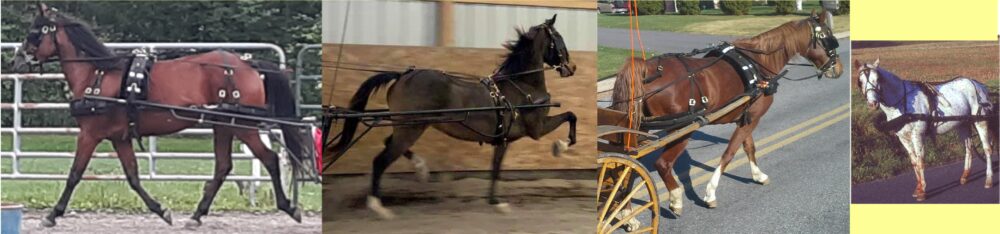
9. Will work with a drag (tarp, sack half filled with sand, light tire, or sledge and harness)
10. Mounts drum or sturdy stand with front feet.
11. Free longes - come when called and respond calmly to driving request - relaxed and eager.
12. When started, leaves without any sign of fleeing; when stopped, plants hind feet and coils loins - does not depend on your hand to stop him.
13. Familiar with being girthed; if necessary, allowing horse to work out any need to buck in pen at liberty.
14. Knows how to back up
15. Loads in trailer (he must know how to back up before loading him in).

...And various people might like to add to this list. Please do...just so long as what you're asking your young horse isn't more than he can physically do. Mentally and emotionally - those are the big areas in getting one started. I've had people act, when I gave them the above facts and advice about starting youngstock, like waiting four years was just MORE than they could possibly stand. I think they feel this way because the list of things which they would like to include as necessary before attempting to ride is very short - their whole focus is on riding as why they bought the animal and they think they have a right to this. Well...the horse, good friend to mankind that he is, will soon show them what HE thinks they have a right to. And what the horse will allow will be more generous, I assure you, than some of these people deserve.

| BACK | HOME |